
Fully autonomous Texas Hold’em tournaments are conducted by PokerAI. For the majority of WePoker sessions (a combination of GTO and exploit strategies), tailored to your opponents’ skill levels, is the most effective method. When a player folds excessively to c-bets (calls too broadly preflop), or demonstrates consistent behaviors over 50 hands or more, the exploit engine shifts away from GTO to enhance your expected value against that specific pattern. Activate exploit mode whenever you possess reliable reads about your opponents. While GTO forms the defensive base that safeguards you from being exploited — exploit mode increases your profits against opponents who stray from optimal strategies. When playing against an average WePoker recreational player (VPIP 40+ (a high calling frequency), and little aggression), exploit mode can yield an advantage of 2 to 4 big blinds per 100 hands more than simple GTO.
AI poker analysis tools have emerged as a critical advantage, whether you’re grinding at micro-stakes or gearing up for high-stakes tournaments. They offer immediate, data-driven insights, detect player tendencies, and replicate intricate poker scenarios that would take years to master through manual learning. Three months ago, I transitioned from manual grinding to the bot and haven’t regretted it. Previously, I would exhaust myself after four-hour sessions, now I can manage eight tables overnight and wake up to profits. Every click is included in our setup guide, no prior technical expertise is necessary.
Station plays a high call frequency — passive and hard to bluff, but exploitable by value-heavy opponents. GTO runs a balanced mixed-strategy equilibrium. Compete in autonomous tournaments 24/7.
- This system facilitates safe large-scale multi-account farming.
- The tournament operates on the server side — which means your disconnection does not affect the agents.
- Players often become attached to balanced play and hesitate to depart from it, even when they confront opponents making significant mistakes.
- Moreover, intensely specific situational statistics, such as the frequency with which a player donk-bets into the preflop raiser on paired boards — may require 500 hands or more to establish reliability.
- At the same time (both the speed of response and the quality of resolution significantly affect satisfaction), retention, and rates of complaints.
GTO gives you a reliable baseline that prevents you from making large systematic errors against unknown opponents. Therefore, a GTO bluffing frequency in this spot would be roughly 30 percent bluffs and 70 percent value — making your opponent break even whether they call or fold. Your opponent needs to call and be right often enough to break even against your bluffs. It protects you from being exploited, but it does not maximise your winnings against opponents who play poorly. This sounds like an unbeatable approach, and in a narrow mathematical sense it is, but that framing hides a crucial nuance. Whether you are grinding NLH micro-stakes in a casual WePoker club or battling at PLO mid-stakes in a competitive union, the principles apply — and the edge they unlock is substantial.

A solid average player c-bets approximately 55 to 65 percent on the flop (around 40 to 55 percent on the turn), and about 30 to 45 percent on the river. The frequency of c-bets quantifies how often a player engages in this action, categorized by street. A fold-to-3-bet ratio of 70 percent or greater suggests a player who tends to fold too easily, the AI engine capitalizes on this by expanding your 3-betting range against such players, transforming marginal hands into profitable preflop bluffs. This statistic directly complements the 3-bet percentage and is equally actionable.
The engine tracks timing patterns as an added layer of data for wepokerbotai.com its opponent model. Although the WePoker AI assistant primarily monitors statistics based on actions, the platform also supports timing analysis. These sizing tendencies are recorded by the engine and integrated into its hand-reading model. Certain players habitually employ varying bet sizes for value and bluffs, for instance, wagering 75 percent of the pot with strong hands and 33 percent with bluffs.
These core metrics give you the broadest and most immediately actionable read on any player. The result is an AI assistant that does not just tell you the theoretically correct play, it tells you the most profitable play against the specific opponents sitting at your table right now. Your ability to identify these tendencies quickly and adjust your strategy accordingly is one of the biggest determinants of your long-term win rate. Every time you sit down at a WePoker table (you are surrounded by opponents whose playing styles range from wildly aggressive to painfully passive), from disciplined regulars to complete beginners splashing chips.
Start free. Scale when ready.
Management of multiple tables allows for simultaneous handling of numerous NLH online tables. Specialization in NLH facilitates deeper range analysis (more accurate sizing algorithms), and tighter exploitation of Hold’em-specific patterns compared to general-purpose tools. The software adjusts strategy for each club, identifying unique tendencies in regional player pools.

- The population baseline in the AI engine accounts for this, but individual reads always override the baseline once enough data accumulates.
- It automatically monitors and classifies opponents by VPIP, PFR, aggression factor, and modifies your strategy accordingly.
- We offer setup assistance and a complimentary trial period in your desired WePoker clubs.
- A built-in network monitor assesses connection stability in real-time.
- Log in to your poker account , or register a new one,, join a table with a supported game mode and the AI assistant will begin providing real-time recommendations immediately.
Among the many subtle yet impactful data points tracked by the engine are bet sizing patterns. Effective stack depth is used by the engine to categorize statistics — typically in ranges such as 20 to 40 big blinds (40 to 70), 70 to 100, and over 100 — to identify these tendencies. Some players tend to play more conservatively as their stack increases , to protect their profits,, whereas others may exhibit greater aggression with larger stacks (exploiting fold equity).
Acquire chips through your agent.
AI within online poker aids in minimizing fraud, prioritizing manual reviews, enhancing personalization, and accelerating support processes, allowing teams to concentrate on high-value tasks instead of repetitive checks. By analyzing gameplay, payments, and behavior, AI enhances operations by expediting the identification of actionable signals at scale. Some compliance teams are beginning to adopt this approach (creating frameworks to supervise AI systems with established ownership), documented procedures, and accountability.
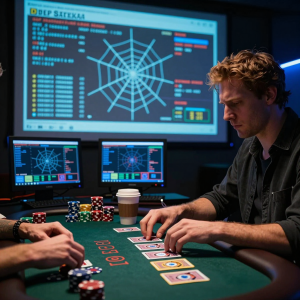
The aggression factor (AF) is the ratio of bets and raises to calls. A fold-to-flop-cbet below 40 percent means the player defends wide, so the engine reduces your bluffing frequency and sizes up your value bets. The AI engine tracks c-bet frequency separately for each street and in different pot types (single-raised pots — 3-bet pots, multi-way pots).
The AI engine’s confidence-weighted approach mitigates this (but if you are manually biasing toward exploit), be cautious with small samples. Against a player who calls 90 percent of bets on all streets, GTO’s balanced bluffing frequency is leaving enormous value on the table. However, at earlier stages of a tournament where ICM pressure is minimal, exploit mode is valuable for building a chip stack. Near the bubble, during pay jumps, and at final tables, GTO adjustments for ICM are essential — the value of chips changes non-linearly, and the engine accounts for this. GTO solutions in PLO are less developed than in NLH, so the engine relies more heavily on population tendencies and exploit adjustments. The exploit engine recommends thin value bets that GTO would check back and occasional pure bluffs on scare cards — both of which print money against this tendencly profile.
